Overview
Focus North is a regional partnership working to transform Caithness and Sutherland into a thriving hub for green energy, innovation, and inclusive economic growth. Building on the region’s strengths it aims to harness the opportunity presented by the Just Transition and the decommissioning of Dounreay. The region already generates 12.5 times more energy than it consumes, has leading wind and tidal assets, and is home to emerging sectors like hydrogen, battery storage, and space technology. Focus North works to ensure local communities benefit economically while also protecting vital natural resources like the Flow Country.
Gap the project addresses
Focus North is responding to long-standing economic and demographic challenges in the far north of Scotland. These include population decline, limited infrastructure, and dependence on public sector and legacy industry employment. The partners are tackling these issues by attracting and developing a skilled workforce, expanding physical and digital infrastructure to support diversification into high-growth sectors. A key focus is to ensure local people and businesses benefit from major renewable and innovation investments in the area. This means helping young people to understand the huge diversity of career opportunities coming to the region and ensuring that the educational pathways are available for them to succeed in these careers.
Ownership model
Focus North is a non-statutory collaboration of key public and private sector stakeholders. It includes Highlands and Islands Enterprise (HIE), NRS Dounreay (Dounreay), the Nuclear Decommissioning Authority (NDA), The Highland Council (HC), Skills Development Scotland (SDS), Caithness Chamber of Commerce (CCoC), and the Scottish Government (SG). Strategic direction comes from a senior-level Board, while an Advisory Board led by Highland Council ensures strong community and third sector engagement.
Development of ownership model
Focus North partnership was originally established as the Caithness and North Sutherland Regeneration Partnership (CNSRP) in 2007. Its original remit was specifically to look at the transition to a post Dounreay economy, addressing concerns about the effect of the major employer in the region reducing employment and finally closing altogether as it decommissioned. At the time of the partnership’s establishment this deadline appeared to be close – with one estimate suggesting it could have been as early as 2022. When established the partnership undertook widespread local consultation, including holding large scale public gatherings to gather a consensus on local economic priorities and this resulted in a Caithness and North Sutherland development plan. This was translated into an action plan that CNSRP partners adopted to be delivered through a delivery group consisting of operational managers from each of the partner organisations.
Programme activity and goals is under continuous scrutiny and review by multiple stakeholders and external consultation, particularly with the changing economic structure of the area (specifically Dounreay end dates, with an end date now expected in 2070, and growth of renewables sector). The revised programme is more focused on attracting local benefit from the immediate opportunities and strengthening and diversifying the economy as a result of these. This new approach was launched at an event in 2022 under the Focus North identity.
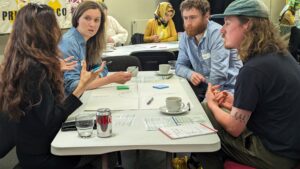
Communication of Focus North activity and feedback on priorities is undertaken through the Board, Advisory Board and engagement with multiple local groups and activities such as:
- A delivery group member is the chair of the Caithness community planning partnership.
- The programme manager is the deputy chair of the Dounreay stakeholder group socio economic committee
- Multiple delivery group members are involved in forums such as the Caithness and Sutherland transport forums. The Caithness forum is run by the Caithness
- Chamber of Commerce – a core Focus North partner.
- The programme manager sits on the UHI North, West and Hebrides ‘North’ Advisory group
- The programme manager is a Trustee of the Flow Country Partnership, working to support the UNESCO World Heritage site and community based economic development as a result of peatland restoration.
- Regular updates are provided to and feedback sought from Highland Council local area committees in Caithness and Sutherland.
- Surveys have been undertaken annually with senior phase students at the local high schools and college to identify key issues and opportunities with this group.
There is a communications programme providing updates via social media and through the local and wider press. This programme includes one major conference event each year where 150+ local stakeholders and the general public attend, scheduled to fit with the school and college timetables.
Policy and funding
Core funding is provided by partners with direct financial support from HIE, and HC. Other partners provide staff time, use of facilities and share expertise and facilities. Project development and implementation are funded by partners on a case-by-case basis. Major recent investments have included spaceport Sutherland and the Saint Ola pier upgrade at Scrabster harbour which benefitted from £millions from The NDA and HIE. HC and CCoC support innovation, infrastructure, and skills. Across the Highlands and Islands private sector projects of more than £100 billion [1] in investment have been identified. These renewable, space, and environmental technology developments align perfectly with national Just Transition and Net Zero policies.
Impact to Date
The region now exports the majority of its energy, powered by a renewable mix that includes over 430 MW of onshore wind and the world’s largest tidal-stream energy project. Offshore wind developments are set to power 2.5 million homes. The Sutherland Spaceport is forecast to bring numerous of jobs. Locally, £117 million of Dounreay’s annual spend remains in the North Highlands economy. These data points reflect strong momentum in building a resilient and innovative low-carbon economy. These opportunities provide a once in a generation chance to establish a diverse low carbon and growing economy in the north of Scotland and reversing longstanding population decline.