2. Contribution to Just Transition
Citizens, communities and place: support affected regions by empowering and invigorating communities and strengthening local economies; Garth is entirely owned by the community and all profits are available for community development. This has allowed our community to pursue projects and ambitions that would be unthinkable without it, and we hope it will continue to do so for many years to come.
Jobs, skills and education: equip people with the skills, education and retraining required to support retention and creation of access to green, fair and high-value work; NYDC now directly employs four staff. We have also extended our industrial estate to cover 14 sites providing local employment. We have taken the local shop into community ownership which currently employs seven staff. We operate a training grant scheme to promote skills/employability and intend to create a training centre as part of our community hub in Sellafirth.
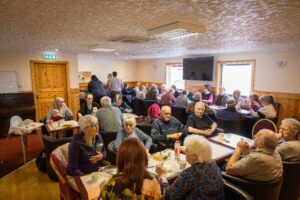
Fair distribution of costs and benefits: address existing economic and social inequality by sharing the benefits of climate action widely, while ensuring that the costs are distributed on the basis of ability to pay; We operate a number of services which are free – a good example of this is our lunch club which averages 60-70 attendees per week. We also operate a number of other social projects and have distributed energy vouchers to all permanent resident households in the area.
Business and Economy: support a strong, dynamic and productive economy which creates wealth and high quality employment across Scotland, upholds the UN Guiding Principles on Business and Human Rights, and continues to make Scotland a great place to do business; we have a developed a sizeable industrial estate at Cullivoe Harbour, and a 28 berth commercial marina, which houses among other vessels 5 sea angling boats. This is a new industry to the area. We also have 5 visiting vessel berths. A local company has recently purchased a boat lift and maintenance/repair of boats is taking place at the marina site. Now the boat lift is available we are also considering offering winter storage of vessels. We also intend to develop a caravan park.
Adaptation and resilience: identify key risks from climate change and set out actions to build resilience to these risks, ensuring our economy is flexible, adaptable and responsive to the changing climate; we have recently worked on projects including setting up resilience hubs at all 7 halls on Yell, to help during power/communication outages.
Environmental protection and restoration: commit to act within our planetary boundaries while protecting and restoring our natural environment; we have been involved in a number of projects relating to peat examination/restoration, and the marine environment around our island.
Decarbonisation and efficiencies: contribute to resource efficient and sustainable economic approaches that actively encourage decarbonisation, support low-carbon investment and infrastructure, and avoid carbon ‘lock-in’; following purchasing two industrial units with support from the Scottish Land Fund we are currently working on a project to turn this into a community hub, and have been informed that the improvements proposed will result in a carbon neutral building.
Benefits to local area and industrial heritage
Garth forms part of the energy transition journey for our community from peat as a fuel, to a diesel operated power station and now on to renewables.
Lessons Learned
Community ownership can generate significant community wealth which can be used to undertake a variety of projects large and small which can regenerate and invigorate communities. We have literally generated millions for the development of our community. The majority of which has now been restricted for housing development, which is critical to the economic and social survival/development of our community. By contrast if an external operator had come in to develop Garth our community would have received £22,500 per annum using current Scottish Government community benefit guidance. The two scenarios are incomparable.
Constraints and challenges
- Repairs and maintenance – failure on the part of our maintenance contractor to repair and maintain our turbines is the issue which most impacts our performance/income. We would like to train our own staff to do this.
- Weather/restricted access – weather can restrict maintenance/repair and being heavily reliant on both the Northlink ferry service from Aberdeen and Shetland Islands Council ferry service to Yell can cause significant restrictions on engineer accessibility. We would like to see a subsea tunnel connecting Yell to Mainland Shetland.
- Satellite communications – failure of satellite communication systems can take down the wind farm. Response times for this have been significantly improved by securing an on-island contractor.
- Market price – as we are tied to the bank, we have to enter into a ppa annually. Market price can fluctuate, sometimes significantly, and knowing when to jump can be tricky.
- Grid connection current – currently one of the electricity cables serving Yell is broken. This has been the case for about a year. If the other cable breaks down we will be unable to export.
- Grid connection future – despite assurances we are still unsure as to what will happen when the new Shetland grid connection goes live.
Replication and scaling
Garth cannot currently be either replicated or scaled up. This is due to grid connection issues. Please see attached press article. In the grand scheme of things, we are tiny. Freeing up small amounts of grid access for similar projects to proceed should be both very achievable and a priority. Look what we’ve done with 4.5mw. A lot of the projects being spoken about now are measured in gw. Room should be made for the small-scale projects too.
Working conditions and fair work practices
Featured organisations and initiatives were asked to supply the following information regarding working conditions:
- Alignment with Scottish Government Fair Work First criteria
- If they have gone beyond Fair Work First by incorporating broader values on fair work
- For larger organisations, whether a union recognition agreement is in place.
This did not apply to co-operatives structures and membership-based initiatives, though all projects and initiatives were given room to provide any detail on fair work practices deemed relevant.
The following information was provided:
NYDC meet FWF criteria, with only four employees.