Contribution to just transition
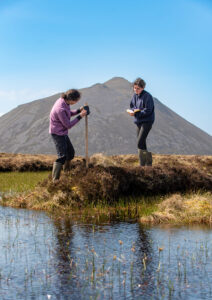
Peatland is the best carbon sink with more carbon stored in the peatlands of the Flow Country than in all the forests in the UK and as such, maintaining and restoring them is one of the key areas in which we can achieve ambitious net zero targets. As such, Scotland’s landscapes have a vital role to play in supporting the ambitious targets for climate change mitigation, highlighted with the key pillars of the Climate Change Plan in the land use sector: peatland restoration and woodland expansion. In 2020, the Scottish Government pledged £250M to deliver 250,000 ha of restoration intervention across Scottish peatlands. A huge challenge was the urgent need to skill up the workforce that could ramp up the delivery from 6000 ha annually in 2019-20 to more than 20,000 ha per year.
UHI North, West and Hebrides holds global research expertise in peatland restoration within its Environmental Research Institute (ERI) and provides a wide provision of courses with relevance to the land-use sector at all levels. However, a new model of delivery was needed targeting the core workforce in the emerging peatland restoration sector, blending research expertise with the practical skills and delivery of the Further Education sector.
In 2024-2025, in partnership with NatureScot’s Peatland ACTION, a UHI North, West and Hebrides team developed and delivered four new short courses in the North Highland region, skilling more than 40 learners and leading to regional growth in the sector. Further courses are already in planning, and the college is in the process of developing a strategy to build pathways for peatlands going forward.
Gap the project addresses
UHI North, West and Hebrides is an anchor institution aiming to have a transformative impact on communities in the North and West Highlands, Skye and Outer Hebrides by encouraging people to live, work and study here. With high depopulation rates in the region and changing demographics, opportunities in new careers and sectors that didn’t exist a decade ago are vital to bring back or retain younger people in the area and sustain a whole supply chain around it. While the need for more skilled contractors for peatland restoration is evident and the focus of a Scottish Government task force, there are still only limited provision of training opportunities in Scotland in the sector. Scotland currently lacks a credible mechanism to build up the skill force needed to deliver restoration at the scale that is urgently needed and support other sectors where the same skills are needed, such as onshore wind and energy infrastructure. Crucially, despite holding the lion’s share of Scottish peatland, the Highlands and Islands region had no provision for training on peatland restoration at all – until UHI North, West and Hebrides partnered up with Peatland ACTION through the “For Peat’s Sake” project.
A key challenge for the team was to design innovative restoration short-courses that could appeal to the two different types of audiences: the digger drivers and machinery operators who deliver restoration on the ground, and the restoration project designers who map, plan and manage the delivery. The courses needed to focus on practical, hands-on skills but to provide enough background information and context to bring in completely new entrants in the sector. With this in mind, the UHI NWH “For Peat’s sake” team worked with NatureScot’s Peatland ACTION to develop two contractor courses (a 5 day one and a 2 day one) incorporating latest research knowledge emerging from ERI, a new introductory course on protected species, and a specialist course on GIS for peatland restoration (online delivery).
Ownership model
“For Peat’s Sake” is a partnership between UHI North, West and Hebrides and NatureScot’s Peatland ACTION but training is owned and delivered by UHI North, West and Hebrides.
Policy and funding
Funding provided by NatureScot’s Peatland ACTION. Initial funding came through the UK Shared Prosperity Fund, through Highland Council but subsequent funding has been directly from Peatland Action.
Impact to date
The training has already been transformational for the region: one of the local contractors who attended the first course in September 2024 was able to secure a large contract and credited the training for giving him more confidence in the opportunities likely to come. He expanded his business and recruited three more operators in his team, who brought families along. In small rural locations, this may be enough to prevent schools from closing. It was picked up by the media, including the BBC, putting a spotlight on the region. Link: https://www.linkedin.com/feed/update/urn:li:activity:7346864459837005824
The demand and appetite for the training in the region was obvious: all the courses were fully booked within hours of being announced, with long waiting lists and participants willing to travel large distances to attend. This spurred UHI North, West and Hebrides to consider the next steps and to start planning for the 2025-26 delivery and to start developing a longer-term strategy for “Peatlands pathways” reflecting the tertiary nature of the college.
This project supports a wide range Just Transition outcomes, including:
- Empowering communities and strengthening local economies – providing learning opportunities that provide local jobs and allow local communities to protect and responsibly manage peatlands for the benefit of their own communities.
- Job, skills and education – providing learning opportunities to support a wide range of people upskill, including those involved in groundswork, restoration project designers, and those working in environmental/sustainable land use.
- Adaption and resilience/environmental protection and restoration/decarbonisation – peatlands play a critical role in mitigating climate change by storing carbon dioxide. In doing so, they cool the climate. They are significant in the fight against climate change and biodiversity loss. Protection of peatlands also support biodiversity loss.
Local and regional industrial heritage
The project was delivered in the world’s first and only peatland World Heritage Site – the Flow Country – a project that UHI North, West and Hebrides also had a leading role in delivering, from inception in 2015 to inscription in 2024. The Flow Country is a vast peat bog that covers much of Caithness and Sutherland in the north of Scotland and stores approximately 400 million tonnes of carbon. It is called blanket bog because it covers the landscape like a blanket and is a type of habitat that is globally rare, but one that is ideally suited to Scotland’s climate and maritime location. The 4,000 sq. km area is home to a hugely complex and fragile ecosystem with a vast array of plants that act as an important defence against climate change.
World Heritage Site status is predicted to help realise a wide range of environmental, social, cultural and economic benefits for the North of Scotland including the creation of skills and job opportunities in landscape restoration and conservation, growth in sustainable tourism and hospitality, and the potential of added value to new green finance models to attract global investment to the area.
Our training supports these ambitions by providing the learning opportunities needed to realise the ambitions.
Benefits to the local area
This project shows not only the potential of working and training in peatlands to deliver a Just Transition with high skilled green jobs, but also the potential of the region to have a big part in it. While it has been delivered in North Highland to date, and in the Flow Country, it has potential to be replicated all over Scotland, if funding was available to support the growth.
Lessons learned
This project has already had a significant impact on the 40+ learners who have completed training and supports NatureScot PEATLAND Action’s objectives. It has also informed development of a longer-term strategy for tertiary learning. This project is unique because it brought together the rich depth of knowledge and research on peatland restoration held across UHI North, West and Hebrides through ERI, along with practical skills and training through its engineering/construction curriculum delivery, creating something completely unique.
Across the courses, we covered everything from the science of how bog breathes to the way in which a digger bucket should be manoeuvred to effectively block a drain on deep peat, from the mapping of a project for Peatland CODE and carbon credit to the surveying of a site for signs of water vole activity. The course is currently free to the participants, thanks to the partnership with NatureScot’s Peatland ACTION – making it both fair and accessible, and opening the sector to completely new learners.
Challenges
Funding continues to be a limiting factor. This project has been made possible thanks to funding from NatureScot PEATLAND ACTION. Staffing capacity to expand the training is also a limiting factor, but this would be possible if funding could be sourced to allow us to recruit additional staff.
Replication and scaling
The project could be scaled up if there was more funding to support staffing and further development. The success of the partnership between UHI North, West and Hebrides and NatureScot confirmed the potential to the college to become a key delivery partner for the national peatland restoration training programme going forward. In time and as confidence in the sector grows from contractors/employers we would envisage that a suitable fee can be charged for these courses which would allow us to retain staff and potentially invest in further programmes, becoming sustainable. However until there is confidence from employers and contractors we urgently need further investment in this area to support growth.
Working conditions and fair work practices
Featured organisations and initiatives were asked to supply the following information regarding working conditions:
- Alignment with Scottish Government Fair Work First criteria
- If they have gone beyond Fair Work First by incorporating broader values on fair work
- For larger organisations, whether a union recognition agreement is in place.
This did not apply to co-operatives structures and membership-based initiatives, though all projects and initiatives were given room to provide any detail on fair work practices deemed relevant.
The following information was provided:
UHI North West and Hebrides Fair Work Practices Aligned to Scottish Government Goals:
- Effective Voice
- Trade Union Recognition: The college recognises and works collaboratively with recognised trade unions (e.g., EIS-FELA, Unison) through structured forums like Joint Negotiating Committees.
- Staff Consultation: There are regular staff engagement mechanisms, including cross campus staff meetings at both staff level and department, all staff forums, and staff ambassador groups to inform decision-making.
- Student Representation: Students have formal representation via the Students’ Association and are involved in shaping services and academic policy.
Opportunity
- Equal Pay and Progression: Regular pay reviews are carried out, and the college adheres to national pay bargaining agreements that promote equal pay and career progression.
- Inclusive Recruitment: Recruitment practices are designed to be inclusive, with guaranteed interview schemes for disabled applicants and widening participation policies to support local and underrepresented talent.
- Skills Development: There is a strong emphasis on continuous professional development (CPD), including digital skills training, leadership development, and access to UHI-wide training platforms.
Security
- Job Security: Where possible, permanent contracts are offered. The college limits the use of zero-hours or casual contracts to appropriate circumstances (e.g., specialist lecturers or short-term demand).
- Living Wage Employer: UHI North West and Hebrides pays at least the Real Living Wage as defined by the Living Wage Foundation, in line with public sector expectations.
- Fair Work First: We comply with Fair Work First principles in procurement and funding applications, a requirement for public sector contracting.
Fulfilment
- Supportive Work Environment: Staff are encouraged to contribute meaningfully to their work through involvement in curriculum development, strategic planning, and local innovation projects
- Career Development: since merger (August 2023) pathways for progression and CPD funding continue to be developed, including support for postgraduate qualifications, leadership programmes, and research opportunities.
- Recognition: Achievement is recognised through appraisal systems, and peer-nominated recognition events for external agencies.
Respect
- Equality, Diversity, and Inclusion (EDI): Strong EDI policies are in place, with active staff and student networks and compliance with the Public Sector Equality Duty.
- Dignity at Work: A zero-tolerance approach to bullying and harassment is backed by clear policies and confidential reporting mechanisms.
- Health and Wellbeing: Staff have access to mental health and wellbeing support, including an Employee Assistance Programme, flexible working, and occupational health services.