Contribution to just transition
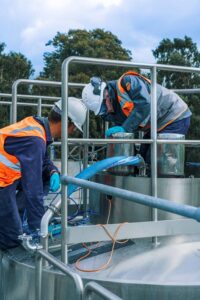
Jobs, skills and education: Our new facility will create around 100 new jobs and continue to transition workers from the oil and gas industry.
- With people joining us from the Oil and Gas industry, they will already be well rounded and experienced in core elements of the process like Health and Safety, Human Machine Interfaces, Pump Operation and Process Monitoring to specified envelopes. We will be running training sessions to help with the conversion to Biotech, both in workshop form and in-process exposure; we have had several people join us over the past year from other sectors who have made the transition and continue to flourish.
Business and Economy: Supporting jobs and educational opportunities in Scotland operating a high quality business that believes in fair and equal opportunities for all.
- Adaptation and resilience: Helping to make sure we can supply our animals, and eventually ourselves, essential Omega 3s without putting more pressure on ocean resources.
Environmental protection and restoration: By transforming waste into a valuable resource, MiAlgae is helping to create a more resilient, sustainable bioeconomy while reducing environmental pressures on both land and sea.
Decarbonisation and efficiencies: MiAlgae offers a low-carbon alternative by producing Omega-3s from microalgae, which:
- Feeds on upcycled waste products instead of requiring energy-intensive inputs.
- Uses 100% renewable energy rather than fossil fuel-powered production.
- Is grown locally, reducing emissions from long-distance transportation.
Regional heritage
MiAlgae’s solution joins the two biggest exports in Scotland – Whisky and Salmon and offers them a more sustainable solution to run their operations.
Benefits to the local area and Scotland
New jobs, Educational opportunities, innovative new green technology: We work with local colleges and universities to offer hands-on learning opportunities through placements, internships, and project work, and get involved in events and talks to raise awareness of green careers and inspire future talent and ensure that local residents have access to pathways into meaningful employment. Internally, we invest in upskilling our employees, many of whom are based locally.
All our roles contribute to the green economy through the development of sustainable biotechnology solutions that reduce waste and support the circular economy. Our operations create green jobs across R&D, engineering, production, operations, and quality, all focus on turning waste into value, directly reducing the environmental impact.
MiAlgae does not have a formal apprenticeship scheme in place at the moment, but it’s something we’re exploring. In the meantime, we do take part in a placement programme for foundation apprentices to join our R&D team focused on building the skills they’d need for lab technician roles.
We collaborate closely with a range of schools, colleges, and universities to support students in getting into the biotech industry through work placements and internships.
We also engage with local colleges and universities to align our skills pipeline with industry needs. Our team regularly participates in local STEM and university events.
Lessons learned
MiAlgae has developed all of its own technology and IP so the whole journey has been a positive learning curve so far, and continues to be so as we grow.
Constraints and challenges
Scaling up from lab to industrial production has introduced challenges, particularly in integrating processes at larger volumes and ensuring seamless transitions between system interfaces. Maintaining adaptability and flexibility has been key to overcoming these hurdles, allowing us to optimise efficiency, refine operations, and sustain momentum during growth phases. These lessons will continue to guide our expansion efforts.
Replication and scaling
MiAlgae’s technology has successfully scaled to industrial production, with commercial quantities now being produced at our commercial demonstrator site in Balfron, Scotland. This facility validates our process at scale and demonstrates its readiness for full market deployment. Last year we were shortlisted for The Earthshot Prize in the ‘Revive our Oceans/’ category.
We are currently about to start building a new facility in Scotland but there are some challenges around securing an appropriate site.
Working conditions and fair work practices
Featured organisations and initiatives were asked to supply the following information regarding working conditions:
- Alignment with Scottish Government Fair Work First criteria
- If they have gone beyond Fair Work First by incorporating broader values on fair work
- For larger organisations, whether a union recognition agreement is in place.
This did not apply to co-operatives structures and membership-based initiatives, though all projects and initiatives were given room to provide any detail on fair work practices deemed relevant.
The following information was provided:
We believe that fair work is not just a compliance issue but a core value that enhances employee wellbeing, productivity, and retention. We go beyond the basic Fair Work First requirements by actively supporting employee wellbeing through health and wellbeing initiatives, investing in the learning and development of our own people, promoting diversity and inclusion, and ensuring transparent pay structures. We are actively reviewing additional measures to further enhance our workplace practices.
While we do not currently have a formal union recognition agreement in place, we maintain open and structured communication channels with employees.