Contribution to just transition
Inequalities hinder the GCR’s ability to attract investment and fulfil its potential. The region has significant untapped economic capacity. Like other UK cities, it lags behind European counterparts in job density and productivity, which are concentrated in central Glasgow. Enhancing connectivity could unlock more of this potential.
Clyde Metro aims to connect unserved and underserved areas, tackling social exclusion through improved connectivity and complementary investment. This supports reductions in deprivation and improvements in health, wellbeing, productivity, and economic activity. The GCR contains 50% of Scotland’s most deprived two deciles, despite having only 33% of the population.
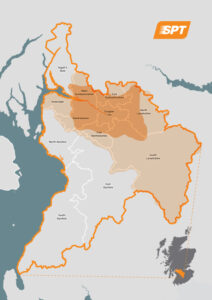
Clyde Metro offers transformational change in economic, environmental, and social outcomes. The region’s diverse places, opportunities, and attractions require better connectivity to realise their full contribution to the GCR and Scotland. Clyde Metro will promote the GCR as a place to live, work, invest, and visit—maximising investment and reducing prosperity gaps.
It will deliver a step change in accessibility, enabling businesses to attract workers and customers, and people to reach more opportunities and services. This supports sustainable place-making and contributes to Net Zero.
Clyde Metro will also improve access to education and training, enhancing immediate opportunities and upskilling the workforce to attract investment.
Its objectives are guided by ‘delivery principles’ applied to the CFI network assessment, including:
- Net reductions in whole life carbon, contributing to Net Zero
- Minimising embodied carbon
- Enhancing built and natural environments
- Applying low carbon technology
Statutory and non-statutory impact assessments are informing the CFI to ensure positive equality and environmental outcomes.
Contribution to regional heritage
The study area is a mix of urban and rural surroundings with a rich natural, built, and cultural environment, including protected ecological areas, heritage assets, and green networks. Clyde Metro has a key role in protecting natural and heritage sites by maximising use of existing infrastructure—such as brownfield sites—sensitively introducing new assets, and promoting mode shift away from less efficient transport. This supports nature recovery by reducing transport-related emissions and pollution, improving access to nature and heritage, and strengthening ecological networks. Clyde Metro also offers opportunities to enhance public transport access to heritage sites. The GCR has extensive vacant and derelict land from its industrial past, which Clyde Metro will help bring back into active use.
Benefits to the local area
Clyde Metro is a once-in-a-generation opportunity to transform the GCR’s public transport network, enabling a step-change in community life chances. It can revitalise communities disadvantaged by inefficient, unreliable, or poorly connected transport—those at risk of ‘transport poverty’. Improved connectivity will enhance community health, wellbeing, and inclusion, supporting a net-zero, climate-resilient economy.
The GCR plays a vital role in Scotland’s economy, contributing over £44 billion in GVA in 2021. Clyde Metro will connect economic growth areas to unlock inward investment and densification, and support national priorities beyond the city centre, including the Glasgow Airport Investment Area. It will link high-density and fast-growing areas with those needing better access to stimulate growth and foster equality.
Lessons learned
Clyde Metro brings together project partners with one goal – to deliver a multi-billion-pound long-term investment programme for a fully integrated mass transit public transport system with the potential to be truly transformative for the GCR and for its communities and residents. During CFI planning stages and subsequent commencement in February 2024, the process has taken positive learning points across several aspects of delivery.
At the core of CFI success so far has been partner collaboration and closer working relations between SPT, GCC and TS. A strong collaborative approach has enabled partners to quickly progress the CFI including establishing funding agreements, overcoming complex procurement processes as well as developing terms of reference and formal reporting and governance structures for CFI delivery. From the outset, this collaborative approach has been pivotal in setting a clear understanding of each partners’ roles and responsibilities and has enabled the CFI to progress at pace.
For the initial stage of the CFI – the Case for Change (CfC) and the Development of Network Options – partners quickly recognised the need for strong engagement and communications approaches to ensure stakeholders are kept fully informed and appraised of CFI progress, and more importantly, that they are given opportunity to input and shape CFI outcomes. Following the positive interest shown in Clyde Metro and levels of participation and engagement in workshops and other discussions, Clyde Metro partners are mirroring this approach through the ongoing CFI work and will look to strengthen and improve how we engage.
Constraints and challenges
Clyde Metro CFI will continue to be a complex process through to its planned completion in early 2027. It faces several challenges along the way, not least, ensuring its extensive programme of planned activity can continue to be delivered within ambitious timescales.
Delivery of the CFI has involved extensive procurement activity, with eight separate consultancy commissions running in parallel, each with several interfaces between them in order to inform the final Programme Business Case and complete the CFI. Whilst structures are in place for managing commissions, this will require close project management by each of the appointed commission leads, however managing commissions interfaces is a known key risk to the success of the CFI.
Given Clyde Metro is a region wide programme designed to address challenges across the area, impacting a range of diverse communities facing different challenges, it is important to continue to ensure support from GCR councils as well as political\wider stakeholders.
Clyde Metro partners require securing funding that will enable it to develop beyond the CFI, including detailed network design and delivery subject to successful business case outcomes. A key challenge, part of the CFI, will be to identify funding and financing opportunities.
Replication and scaling
Clyde Metro in its development will be examined alongside bus reform for the west of Scotland through our Strathclyde Regional Bus Strategy. The two of these major workstreams, when combined will help support a much more cohesive and integrated transport network for the GCR.
Working conditions and fair work practices
Featured organisations and initiatives were asked to supply the following information regarding working conditions:
- Alignment with Scottish Government Fair Work First criteria
- If they have gone beyond Fair Work First by incorporating broader values on fair work
- For larger organisations, whether a union recognition agreement is in place.
This did not apply to co-operatives structures and membership-based initiatives, though all projects and initiatives were given room to provide any detail on fair work practices deemed relevant.
The following information was provided:
Real Living Wage[1]: Payment of the Living Wage is seen to be a significant indicator of an employer’s commitment to fair work practices and is one of the clearest ways that an employer can demonstrate that it takes a positive approach to its workforce. SPT pays the Living Wage to its employees and uplifts its pay levels each year accordingly to maintain this. SPT has in addition attained Glasgow Living Wage Accreditation[2].
Effective Workers Voice[3]: In 2024, SPT introduced a new Recognition & Partnership Agreement in alignment with the ACAS Guide on Trade Union and Employee Representation and the Code of Practice on Time Off for Trade Union Duties and Activities. This replaced the previous Information and Consultation of Employees (ICE) Agreement, which was recognised as needing modernisation to reflect current best practice and strengthen collaborative working.
Enhancing Community Benefits Through Inclusive and Industry-Focused Procurement[4]: SPT applies a community benefits process to all Regulated procurements, however over the course of our Procurement Strategy, we look to focus benefits realised where possible to the transport industry and in particular to areas where there is an aging workforce and a present and future skills gap. The monitoring and delivery of any resultant community benefits is undertaken by Procurement and project managers. In our procurement, SPT seeks to maximise opportunities to secure a full range of community benefits including training and employment by facilitating business growth of SME, third sector and supported businesses from its procurement activities.
Fair Work First in Our Procurement[5]: SPT is committed to the delivery of high-quality public services and recognises that this is critically dependent on a workforce that is well rewarded, well-motivated, well-led, diverse, has access to opportunities for training and skills development and is involved in decision making. In order to ensure the highest standards of service quality we expect contractors to take a similarly positive approach to fair work practices as part of a fair and equitable employment and reward package. Bidders are asked to provide details of the fair work practices embedded within their organisation as part of any procurement exercise in excess of £50,000, unless inclusion of this criteria is deemed inappropriate.
Suppliers are encouraged to provide support to their employees for learning and development and give clear commitment to nurture talent to help individuals fulfil their potential. They are encouraged to promote equality of opportunity and develop a workforce which reflects the population in terms of age, gender, religion or belief, race, sexual orientation and disability.